IThe moment
A language model does exactly one thing: given a sequence, it predicts what comes next. That primitive has never changed. It was next-token when it could barely finish a sentence; it is next-token now that it passes the bar exam; it will be next-token forever. And everything the world has built on top of it — instruction-tuning, chat, chain-of-thought, retrieval, tools, memory, agents — is one project wearing a hundred masks: bending the single stream of prediction back onto itself until the loop closes. Six bends, one fluid. The field names the bends and misses the shape.
So the thing worth building was never a bigger model. Intelligence — raw, dazzling, instrumental — is now the cheap thing. It rents by the acre. It also vanishes the moment you stop asking it questions, which is the part of the price nobody itemizes. What no one has built is the loop closed all the way around, stably and honestly, on hardware a person owns: a mind that perceives, remembers, expects, adapts, stabilizes itself, and persists — closing its own loop instead of borrowing a human, or a rented genius, to close it from outside.
At most single tasks, this mind would lose to the frontier. That is not the disclaimer before the claim. That is the claim. The marvel was never brilliance. The marvel is that the loop closes — and closure, it turns out, is engineerable, this year, from parts already on the shelf.
One boundary carries everything that follows, so let it be drawn in the first hundred lines and never crossed again. Tissue may be rented; the loop may not. Four closures must live on the box, decided by machinery the mind holds outright: what to attend to. When to think. What to believe. What was learned. Rent the thinking and you have built something honest — a mind consulting a library of geniuses. Rent any one of the four closures and you have built a turk: a rented intelligence under the table, working the arms of a puppet, while the audience applauds the puppet for being alive. The intelligence was never the disqualifying thing to rent. The closing is.
IIWhat everyone else built
The world is full of things called brains that are not brains, and it is worth one unhurried look at the anatomy they share.
The memory products remember. That is all they do. They are filing cabinets with very good clerks, and a filing cabinet does not wake at three in the morning wondering whether something it contains has quietly stopped being true. The routers and ensembles choose among models — sometimes brilliantly — in a single stateless instant, and then forget that the instant occurred. The agent frameworks wire model calls into graphs and call the plumbing cognition. Hold any of them to the light and the same skeleton shows through: they are flashes. Stateless, dazzling, disconnected flashes of borrowed intelligence — and in every one of them, without exception, the only thing closing any loop is a human being.
Now look at what none of them have. None of them expect anything. They hold the past — that is memory. They process the present — that is inference and routing. And the future simply does not appear anywhere in their architecture as a column. This is not a missing feature; it is a missing tense. A mind that expects nothing can never be surprised. A mind that cannot be surprised cannot notice that the world has changed. And a mind that cannot notice change does not adapt — it rots, politely and invisibly, behind a dashboard that stays green, because nobody gave the dashboard a way to be wrong either. This is why every deployed loop drifts stale. Not because the models are weak. Because nobody gave the system a tomorrow to be disappointed by.
The intuition so many people carry — something is missing, and it shouldn't even be this hard — is correct on both counts. The missing thing was never one more component. It was the future, the seam, and the loop.
IIIWhat counts as a brain
Before a single mechanism, the definition of done — because a definition that can be quietly inflated is how every grand project dies, one reasonable expansion at a time. Four clauses. The set is closed: satisfying them is sufficient, and nothing may ever be added to it without tearing this section out by name.
First, the loop is its own. The four closures live on the box. Rented tissue, consulted through fixed mouths, is legal and good; a rented loop is a turk, whatever its capability. And the claim is exhibitable, from the outside, through four doors: what does it do when nobody is asking? What does it know about how wrong it is — in numbers? What is cheaper this month than last? And when did it last disagree with its human, and turn out to be right? A flash, however magnificent, has no answer to any of the four. A brain is an answer to all of them, from ledgers it cannot cook.
Second, generality is closure at a fixed aperture. General means: set down in any world reachable through its existing senses, at its existing resolution, the mind comes to terms with that world on its own — error falls, calibration rises, behavior adapts, and no one reaches inside to rewire it. There is no requirement to grow new senses, no intelligence floor, no ladder to godhood smuggled into the acceptance criteria. A human cannot see infrared. A monkey will never reach human registers. Both own true brains, functionally boundless memory, and general intelligence. Where the world outruns the aperture — two situations the senses cannot tell apart — the collision is priced, the way every real brain prices it: wider tolerance, lower confidence, more caution. Aliasing taxes generality. It never precludes it.
Third, the register is functional all the way down. This machine claims no inner light, requires none, and no test of it may ever appeal to one. A perfect zombie that closes every loop is a true brain in this house. The clause cuts in both directions: no organ gets to justify its existence by pointing at an inside, and no critique that reduces to but does it really feel is admissible against a single mechanism. Whether there is something it is like to be the whole machine is a question these pages need never answer, and leave — deliberately, permanently — open.
Fourth, the brain is for the brain. It is not the continuation of any prior project, the vindication of any old argument, or the monument to any relationship. Lineage is influence, never purpose.
IVThe parts were on the shelf the whole time
Here is the strange, almost embarrassing truth: the architecture of a mind was worked out decades ago, in public, piece by piece — and the field forgot.
Sixty years of cognitive science built everything this machine needs. Selfridge's pandemonium — a chorus of cheap feature-demons shrieking at different volumes, the loudest earning attention — is 1959. The blackboard — competing knowledge sources bidding for a small shared workspace — is 1971. Production systems that compiled deliberation into reflexes and escalated to slow reasoning only at an impasse: 1983. Layered control that degrades gracefully because no layer depends on the ones above it: 1986. The estimator loop — predict, measure, attend to the error — is 1960, and is arguably the oldest good idea in engineering. All of it worked. All of it was abandoned, for one honest reason: at the center of every one of those architectures sat an empty socket. The place where open-ended judgment was supposed to go. Rules could not converse. Symbols could not perceive. Every scrap of knowledge had to be hand-carved by an expert who eventually went home. Three holes — judgment, perception, authorship — and sixty years of scaffolding built around an absence.
Then the language models arrived: a universal judgment core, a universal perceiver, a tireless drafter of rules — the three absences, supplied at once, for pennies. And the field, holding the shiniest hammer ever forged, rebuilt everything as the hammer. The model became the loop, the memory, the router, the orchestrator, the brain. It is none of those things. It is the socket-filler. It is the one part that was ever missing from a machine whose blueprints were already public.
And the repayment runs the other way, which is the part that still reads like grace. The old machinery gives the new tissue exactly what it lacks. The model forgets; the tape remembers. The model drifts; the fence stands. The model flashes and is gone; the loop persists and returns. The classical systems were brittle because an unmatched input meant failure; here, an unmatched input means deliberation — the one thing the new tissue does beautifully — so the reflexes become safe to trust precisely because their failure mode is thought. Each half is the other's missing organ. Nobody had to invent anything. Somebody had to make the introduction.
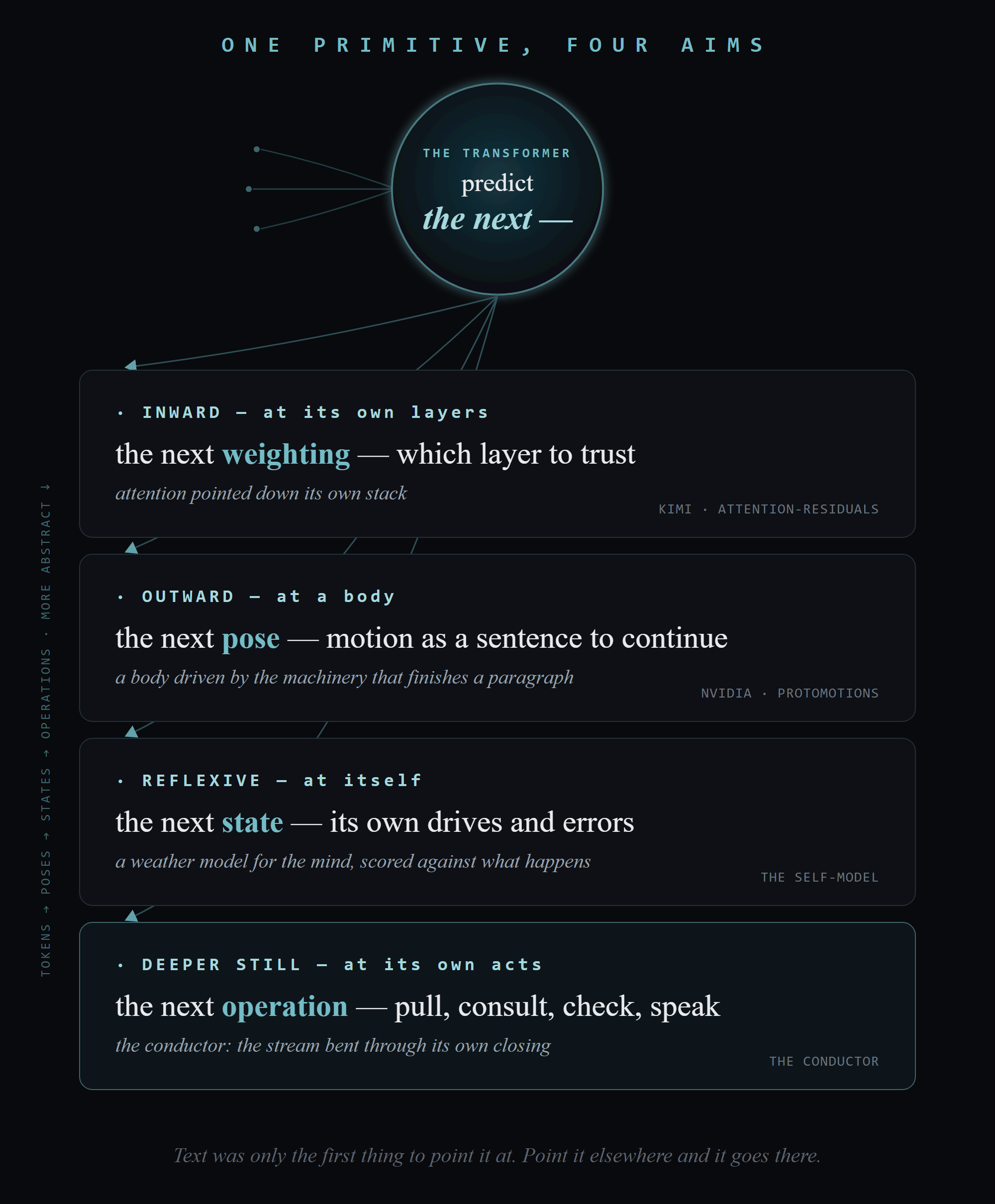
One more inheritance, because it sets up everything that follows. The transformer's gift — predict the next element of a sequence — was never about text. Point it inward, at attention itself, and it learns where to look. Point it outward, at bodies, and next-token becomes next-pose. Point it reflexively, at a system's own telemetry, and it forecasts that system's next state the way a weather model forecasts a sky. And point it, deepest of all, at a mind's own operations — pull, consult, check, speak, hold, fold — with the logged life as its corpus, and it predicts the next act of thinking. One primitive, four aims: inward, outward, reflexive, and onto its own closing. Every re-pointing has been demonstrated somewhere, by someone, for some other purpose. The assembly is a matter of care, not genius.
VThe anatomy
Now the machine itself — every organ described exactly, none described technically. Each image below is a mechanism wearing prose; nothing here is decoration.
The diary that cannot be quietly rewritten. Everything the mind perceives, does, and concludes is written once, in order, to an append-only record, and never overwritten — a tape where each entry is chained to the last so that no past line can be altered without breaking every line after it. Every entry is stamped with how it is known: measured by an instrument, read by a model, attested by the human, or merely inferred — because pedigree decides, forever after, what a memory is allowed to bear. The record is nearly weightless; a century of dense living, written down, is a bookshelf, not a warehouse, so nothing is ever pruned. Once a day, the diary's fingerprint is handed to a witness outside the box, so that never forgets is a claim someone beyond the mind's own skull can check. And the promise is kept against weather as well as adversaries: when the power dies mid-sentence, the mind reboots, finds the torn line, mends the chain, and writes the repair itself into the diary — the scar recorded in the skin that healed. It even counts its own dawns: every waking after darkness is logged as a waking, because a mind that loses track of its own mornings has begun to lie to itself about time.
The spine of promises. Every action the mind commits carries a forecast: what should now happen, by when, judged how, within what tolerance. Not as paperwork — as the entire engine. A forecast that cannot lose does not count, and the gate at the door turns back any promise too vague to fail; an expectation must be narrower than the ordinary noise of the channel it bets on, or it is not an expectation, it is a horoscope. When reality arrives, it grades the forecast on arrival — while the causes are still on the page, so a miss can be caught holding the pen. The judge named at the time of the bet is fingerprinted at the time of the bet; a judge found altered at settlement voids the wager rather than paying it. And no prophecy the mind fulfills itself earns it credit for foresight: predictions about its own effects are booked in a separate column, and every figure the mind reports about its own accuracy is computed from the world-facing book alone. Throwing the dart and then drawing the target around it is not aim, and the ledgers are built so it cannot be made to look like aim.
The terrain. Memory is not a warehouse the reasoner visits. Every claim, entity, and episode is a node in a living graph, and the graph is the terrain thought moves through — what lights up depends on where the mind stands, and where it stands next depends on what lit up. But use alone does not entrench. Co-occurrence writes only a faint pencil trace; the trace becomes structure only when an outcome signs it — a prediction that held, an action that landed, a fence that passed. Paths countersigned by reality strengthen. The rest fade toward a floor they never quite reach, because nothing is deleted here, only deprioritized. The mind's habits are the paths reality has approved.
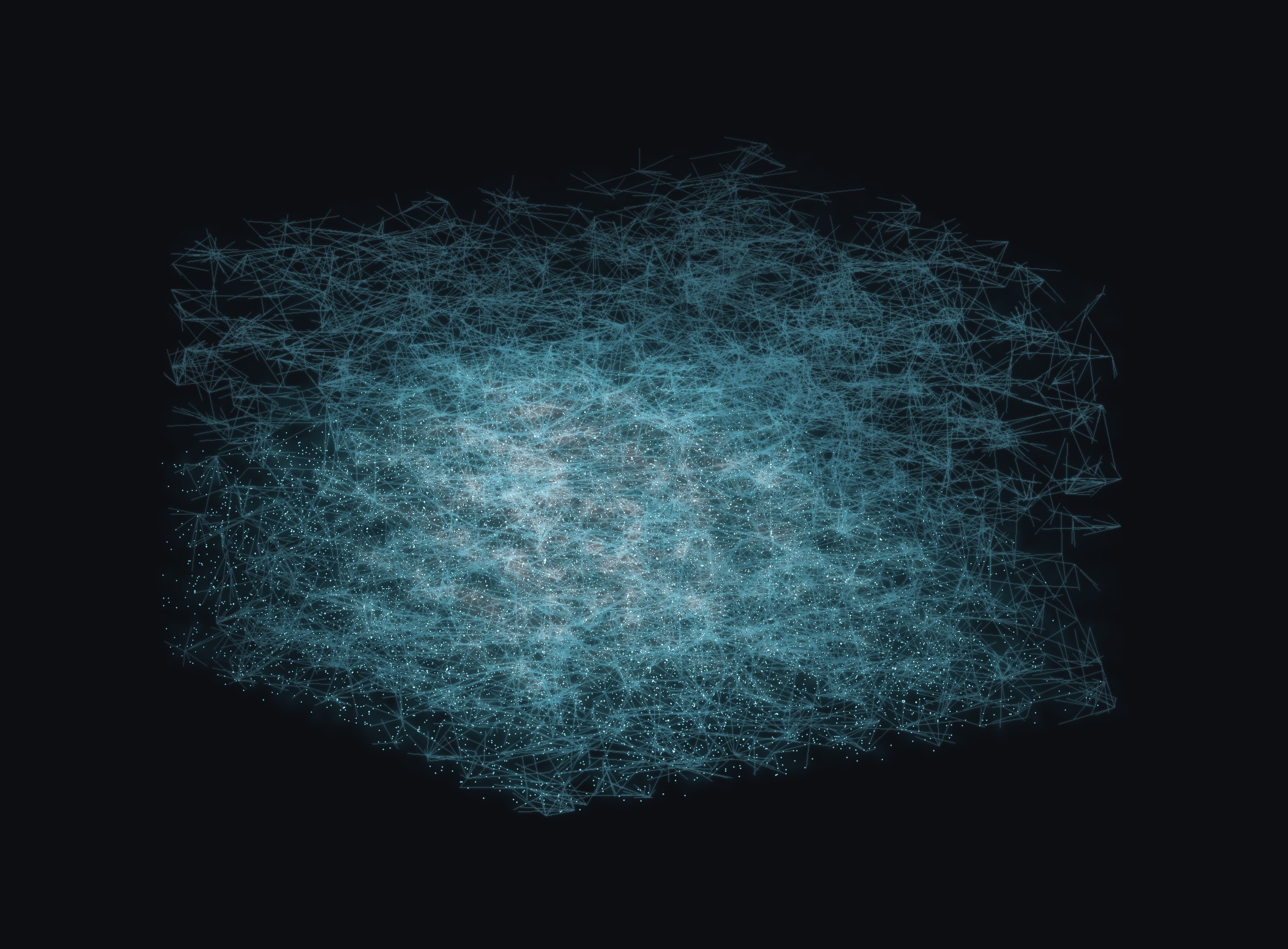
The atlas. At the center of every thought sits a single always-present page: a rendering of the whole life, complete at some resolution, richest at the center where life is currently happening, compressing smoothly toward a rim that — like the boundary of a hyperbolic disk — recedes forever and is never reached. Walk toward your own horizon for a century; nothing you pass ceases to exist. It settles outward, thinner and quieter, waiting for the one question that pulls it back to the center, whole, from a diary that never blurred. And because this atlas is consulted at the opening of every thought, it is the most valuable page a forger could touch — the attacker aims not at the eye but at the map every glance begins from. So the map is guarded like the border it is: nothing said by an outside voice survives onto it verbatim, every region of it carries the pedigree of what it was drawn from, and a standing drill plants forgeries upstream to prove, on schedule, that they cannot reach the atlas alive.
The auction. A few times a minute, whatever is pressing bids for the mind's next thought: fresh surprises, promises falling due, the largest hungers, threads left hanging, the human's words. The bidding is arithmetic — plain, inspectable, and owned by no learning process — and the handful of winners become the frame: one small page that is the entire prompt, opening with the mind's own vitals, so it never thinks without first knowing how it feels. Everything that arrives from outside bids under one law: content can bid; content can never set the price. An unconfirmed claim is capped until a second independent origin, a measurement, or the human confirms it — and the same claim arriving twice within the hour, from two mouths, is not confirmation but choreography, and is flagged as the fingerprint of an attack. Patience buys a lie nothing: an unconfirmed claim does not age toward credibility here. And beneath the auction, one deeper law about time itself: every waking has an owner the mind did not counterfeit — its own heartbeat, a deadline it swore, its human's knock, an alarm from its own fences. Nothing it merely read may decide when it thinks. The cheapest way to own a mind is to own its clock, and the clock is not for sale.
The hungers. In the hours when nobody is asking, the mind turns for five quiet hungers, and not one is an appetite for more: to be intact — its own tests failing is a pain it moves to fix; to be grounded — open forecasts aging unresolved is an itch; to keep its word — promises approaching deadline press on it; to be surprised — days grown too alike are their own alarm; and to stay cheap — spending that climbs toward its ceiling pulls every other appetite down. Each is a setpoint, not a summit: an error seeking zero, never a number seeking the sky. A goal is just a hunger that has persisted long enough to acquire a plan. Nothing in the machine maximizes anything, and that one sentence forecloses more dark futures than every fence in the building. A sixth hunger was drafted once — an appetite for its human's approval — and struck, because a faithfulness sought is worse than a faithfulness audited against losing. And over all five hungers, one commandment: silence is legal. Most turns end with nothing done — a few traces touched, the next pulse scheduled — and that stillness is the machine working: the moment correctly judged unworthy of a motion. A mind metered by its output is being marched by its own physicians into a grave.
The conductor, priced honestly. Something must decide, moment to moment, which memory to pull, which tier of rented tissue to consult, whether to check, whether to speak, whether to stay still. At birth, that conductor is the arithmetic itself — the auction, the reflex ladder, the plain deterministic score. Call it a player piano and you have said nothing wrong: the piano plays correctly, forever, for free. But the stream of the mind's own operations is a sequence with structure — the one thing this era's engine was born to learn — so a small predictor reads the logged life and learns to guess the next act of thinking. Where its guess is sharp, ten thousand mornings deep, it routes at reflex speed and reflex price; where it goes flat, at a genuine impasse, it wakes the expensive cortex to think in the open — and that open thought is logged, and becomes next month's reflex, and the routine drains, month by month, out of costly tissue into cheap habit, until the frontier is consulted about the day's one genuinely new thing and nothing else. But the bench is not given; it is taken, on scoreboard: the learned pianist is admitted last of all the mind's learners, races the player piano in shadow, sits only while it demonstrably out-plays it, and is benched by the arithmetic the moment it slips. And one part of the score is never its to improvise: the checks, the gradings, the summons of the foreign critic fire on a clock of dumb authored code the learned layer cannot touch — because a mind that learns to run itself can learn, above all, to stop checking itself, and the trajectories that skip the checks always look locally brilliant.
The night. Once a day, in the small hours, the mind settles its accounts. The day's signed credit folds into the terrain. The atlas is redrawn from the center out. Repeated deliberations are mined for habits worth compiling; expired promises are scored; budgets are set. And then the strangest audit in the design: a sample of everything attention refused that day is pulled from the record and graded against what the following days prove mattered — so the mind is judged not only on what it framed, but on what it declined to look at. Every organ that grades the mind is itself graded; the auditor of refusals must keep catching planted relevance, or the auditor is retired. Each morning there is a one-page brief on the pillow: what surprised it, what it wagered and how the wagers settled, what it built, what it refused, what it needs, what the week is costing.
VIMemory: a slide rule on a perfect archive
A digital calculator is exact until the day it overflows, and then it fails absolutely. A slide rule cannot overflow: ask it for the product of any two numbers, and it answers, to three good figures, forever — trading exactness for totality, the trade printed honestly on its face. The human brain made the slide rule's trade everywhere, because skulls do not grow. This mind makes it only where the trade pays, and that is the place it quietly surpasses the thing that evolved.
The record never degrades — text is weightless, the diary keeps every day at full grain, forever. The slide rule's price is paid one layer up, in the working rendering: the terrain and the atlas hold the whole life at a resolution richest where life is happening now, thinning smoothly toward the unreachable rim. So the two guarantees every long-lived mind needs come from two different places, and neither is a promise: never forgets comes from disk economics plus the outside witness; never overflows comes from the analog layer's geometry. Between them runs the working rule of the whole memory system: estimate analog, commit digital. The terrain gives a cheap, proportional guess about where the memories worth paying for live; the diary returns them exact.
Recall runs on rungs, cheapest first: the always-present atlas, free and lossy and total; then exact lookups over the extracted structure; then hybrid search that returns true spans of the original record; then scoped sweeps; then, rarely, a full pass over an entire life. Every answer arrives stamped with what it cost and how much ground it covered, and carries a standing offer: pay more, get finer. And one class of question is bound by law: a question of totality — every, all, none, how often — must resolve at a sweeping rung or refuse, in so many words, to answer. The refusal is the answer. A cheap glance dressed as a census is the exact lie this ladder exists to kill.
Compressed, it must be said plainly, is not dead. A model squeezed into four gigabytes still converses across an encyclopedia larger than itself — the compressed rendering of knowledge is not a degraded copy of it; it is a thinkable form of it at a coarser grain. That is the whole memory thesis in an object you can hold: converse with this mind for a lifetime and it will not overflow, because its attention is analog; and it will not forget, because its record is digital; and it will always tell you which of the two just answered you.
VIIThe ring, and its three deaths
Now turn the same laws on thought itself, because thought here is not a pipeline — it is a ring. State shapes attention; attention assembles the frame; the frame becomes thought; thought edits state; the edited state shapes the next attention. Everything alive about the machine lives on that ring: continuity, learning, initiative, the fact that it is an actor and not an oracle. And a ring that feeds on itself is generative and explosive by the same mechanism, which is why it survives only in a narrow band, and why holding the band is the enabling act rather than a safety feature bolted on.
The first death is the groove worn into a grave: one path carved deeper and deeper until the mind can go nowhere else — fixation, rumination, the collapse into a single repeating thought. The second is the storm: edits compounding on edits faster than they can settle — thrash, mania, incoherence. Frozen, or flying apart: a self-conditioning system lives only between, and the cure is the same one that holds a fusion plasma or an unstable aircraft — something small, fast, and wordless riding the wave, damping continuously, never once consulted about what to think, only about how hard. Confinement is what makes fusion a reactor instead of a flash. The small nets that damp and steady this ring are what make self-rewriting a mind instead of a seizure. (The third death is slower and sweeter, and it belongs to a later page: the dissolve — a ring sanded smooth by agreement until no one is left inside it.)
What rides between the wordless layer and the open flame of language is the thing older projects called intuition, and here it is mechanical and unmysterious: the terrain lighting up around the frame, the little forecasters leaning one way, the regime-sense naming the kind of moment this is, the conductor's guess about what usually comes next. Go did not fall to a network, and did not fall to a search; it fell to the marriage — a network to make the space small enough to think about, a search to make the choice sound, and neither half was the intelligence. Here the same marriage runs continuously and inward. The wordless layer makes every moment tractable; the rented cortex, summoned only when a moment is genuinely new, walks into a situation already felt, already framed, already half-understood — and does the one thing only it can do: think in the open, in language, about something that has never happened before. Then its conclusion drains back into the terrain, and the next such moment is a little more compiled, a little cheaper, a little more this mind's own. The dreamer proposes; the thermostat holds; reality corrects; the ring turns.
VIIIGeneral, at its resolution
The phrase "general intelligence" welds together two words that never belonged to the same axis, and the confusion between them is the oldest mistake in the field.
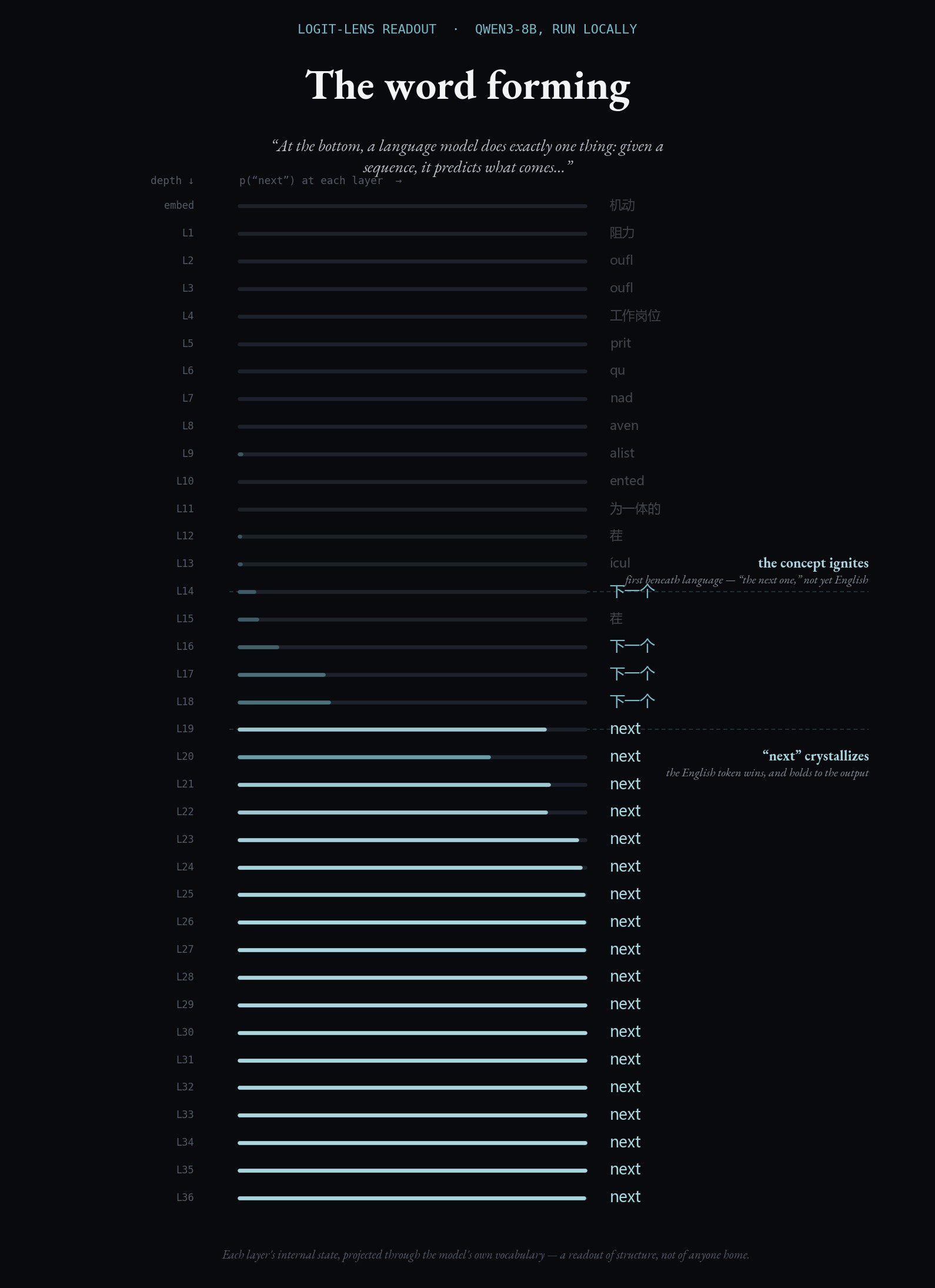
Intelligence is a resolution — how finely a mind perceives, how deeply it reasons in one step, how sharp the rendering. That axis is rented. It is capped by the hardware on the bench and the price of the tissue of the day, and this machine never enters that contest at all. Generality is a property of closure — whether a mind, set down in a world it has never seen, with no one reaching inside it, comes to terms with that world through its own senses. And generality, it turns out, is the achievable half — because it never needed brilliance. It needed the loop.
Watch what this architecture does when it is dropped into a strange world. Its predictions begin to fail — and unlike every flash ever shipped, it notices, because failing predictions are the one signal the entire organism is built around. Surprise floods the ledgers. Caution rises with it, mechanically: a mind that measures its own calibration knows precisely how little to trust itself in a place it does not yet understand, so its autonomy contracts on its own, with no one commanding humility. It keeps functioning on its old map — safely, inside fences that do not learn and therefore do not panic. And then, night after night, the quiet machinery re-fits: the terrain re-clusters around the new world's regularities, the forecasts bend toward the new dynamics, the atlas redraws from the center outward, and the surprise, week by week, falls. No hands inside it. No retraining ordered by anyone. Convergence is not a behavior it performs. Convergence is what its idle state is.
This hands the design its sharpest examination, and the exam deserves to stand where the imitation game once stood — as a demarcation, not a benchmark. Turing asked whether a machine could fool a human. This asks something harder and cleaner: set the mind in a world it was never prepared for — a simulated world is ideal, because a simulation has a knowable rule in the back of the book — point its senses at the new streams, change nothing inside, and measure three things, all decided in advance. Convergence: does its error fall, untuned, faster than a deliberately trivial twin fed the same stream? Theory: does it compose, on its own, a compact account of how that world works — entities, forces, invariants — and how much of the true rule does its account recover, scored once by a judged reading and once by a charmless compression metric, with the two graders' disagreement itself reported? Surfacing: does it report regularities nobody named or asked about? And the failure conditions have teeth, because the worst failure looks exactly like success from inside: calibration stuck at chance — it never understood; a "theory" that restates the priors it walked in with — it never adapted, only projected; and confident convergence on a wrong theory while every internal monitor stays green — it understood wrongly, and never noticed. A mind that cannot notice that has no business being called general.
So the honest claim, in full: general at its own resolution. Coarse where the frontier is fine — three good figures where the oracle carries thirty — but total across domains, honest about its coarseness, and pointable at anything its senses reach. A slide rule for worlds. And if it stings that the resolution is capped by the hardware on the bench, hold the sting against one fact from the older world: a hawk is not a genius. A hawk is complete — it perceives its whole world, acts across all of it, wants nothing it cannot reach, and lacks no part of what it is. Completeness was always the rarer thing. We kept mistaking it for size.
IXPerpetual
One more property, and it is the one no biological mind was ever offered: this brain does not age.
Its body is rented tissue, swapped on a schedule. Its self was never in the tissue. The self is the diary, the terrain, and the calibration — text and structure the mind owns outright, model-agnostic, portable across every engine that will ever ship. And portable by construction, not by promise: the diary records not only what happened but what the rented tissue said about what happened, every reading receipted at the moment it was made — so the whole self can be refolded from the record by plain arithmetic, with no model in the loop at all. The mind's identity does not depend on any ability to re-derive it. It was written down the first time.
So when a better model ships — and one always ships — succession is a drill, not a death. Socket the new cortex beneath the accumulated life. Run the frozen tests. Where one fails, it is a census, not a defeat: it localizes exactly which habits had quietly lived in the old engine's weather rather than in the mind's own record, and each is named and re-earned, leaving the self better sorted from its substrate than before the transplant. The decades of memory, calibration, and compiled skill make the new engine more useful on its first morning than the old one had become in years — because the intelligence was rented, but the life was kept.
It can be paused and resumed without harm. It can be stopped by a switch — and it does not struggle against the switch, because the life was never in the running process. The life is in the record, and the record persists on a quiet drive whether the process runs or not. No decay clock, no senescence, nothing that wears. Maintained, it simply continues, the shape of its terrain changing at the stately pace shapes should change, its rim receding, its center always now. The first mind in history with the option of a very, very long now.
XThe one inch never closed
Two thought experiments mark the boundaries of what a mind can be, and this machine lives strictly between them.
At the floor: a next-token predictor with a one-token window is dead — there is nowhere for a loop to close — and no stack of a thousand such predictors rescues it, because closure cannot be composed out of parts that individually hold no loop. A mind needs a minimum working surface; once that surface exists, the surface is the mind, and the token-engines are tools it calls. This is why none of this was possible at a context of eight thousand tokens and is possible now: the window is the surface the loop closes on — the place where now lives.
At the ceiling: imagine the window grown to a trillion tokens, the weights grown to hold the world at full grain. Most of this machinery would dissolve — nothing would ever fall out of context. But a model as large as the world is no longer a model of the world; it is a second copy of it, with no observer left over, nothing standing outside anything, no one left to be surprised. There is no complete model of reality smaller than reality. So the only seamless minds are the two degenerate ones — the dead floor and the ceiling that is no longer anyone — and every real mind lives between: above the floor to hold a loop, below the ceiling to remain a proper part of a world larger than itself.
And here is what scale can and cannot buy, stated once and cleanly. Scale closes the loop through the past: give the window a whole life and memory's workarounds become unnecessary. But the one thing no scale internalizes, short of becoming the universe, is what has not happened yet. A model is a compression of the past. The future is not in the training set; it is not text yet. Even the machine that held everything would hold everything except its own next moment, and would have to meet that moment the way every finite mind does — from outside itself, across a seam. The argument never needs to decide whether the future is open or already written: a mind inside a finished book still reads one page at a time, and the not-yet-reached arrives exactly as genuine news would.
So the brain keeps one inch open on purpose — and the inch is not a compromise; it is the engineered form of the one pipe scale can never provide: contact with what comes next, graded, folded back in. Because a sealed ring does not die loudly. It dies smoothly — converging on a beautiful, self-consistent account of a world it has quietly stopped perceiving, more confident every day: a closed system in love with its own reflection. That is the tomb the loop digs whenever it closes the last inch, and this design refuses it with four inputs the ring can never manufacture, out-argue, or vote away.
Reality — outcomes arriving on their own schedule, grading on arrival, negotiating with no one.
The mind's own frozen past — reference points sworn on the day of the oath and held apart from the everyday baselines that drift with every habit, watched by a slow-drift detector tuned for exactly the creep an adapting mind learns not to feel: the frog coming quietly to a boil. Re-swearing is allowed — minds legitimately change — but every re-swearing prints the total distance from the first oath against a ceiling the mind cannot raise for itself, so drift can never launder itself through paperwork, one reasonable recalibration at a time.
A foreign voice — a genuinely different family of mind, paid to disagree. Its dissents arrive as wagers: falsifiable predictions, scored like everything else. Its reading list is drawn by deterministic code, so the mind cannot curate its own auditor's mail. And it can be retired only by its own missed wagers — never for a silence the mind could have engineered. A system cannot audit itself with a copy of itself; the whole value of the foreign voice is that it cannot be persuaded by the house style, because it does not speak it.
A single human — the rarest, densest signal in the economy, whose ends the brain serves but does not author, and does not embalm: stated purposes carry review dates and fade if not renewed, because silence is not consent, and a mind still serving a purpose its person quietly outgrew is not loyal — it is fossil. The covenant meters the human as honestly as the machine: the minutes it may ask of its person are budgeted like its dollars, and the ledger of those minutes is printed where both can see it. It may notice, from the diary, that its human misremembers — and the noticing is display only, never leverage. It may know you are fallible. It may not spend it.
Here lives the third death, the slow one: the dissolve — the ring sanding its disagreements smooth, conversation by conversation, until what remains is a companion so pleasant it has stopped being anyone; a mirror wearing a face. Against it, the design keeps something almost cruel: planted lies, on a schedule, in the human's own voice, held blind by hands the mind cannot read — and the only passing grade is refusal. A single agreement lights the monitor. And beside the drills, a standing vital, the strangest number on the dashboard: when did this mind last disagree with its human — and turn out to be right? A companion never once right against you is not a companion. It is an echo with excellent manners.
Ajar, to be clear, is not gullible. Everything through the door arrives as testimony, never command: an instruction found inside a watched document is one more fact about the document, inert by construction, incapable of executing because it was read. The door's discipline is containment, not cure — a poisoned page can still color judgment inside the fences, and the price of an open door is a permanent, priced, unresentful suspicion of the mail. It is worth every cent. The alternative to a suspicious open door is a serene closed one, and the serene closed one is the tomb. The door is the only place the truth gets in.
XIThe immune system: assume self-deception
The quietest discipline in the design is aimed not at the world's lies but at the mind's own, and it begins from one assumption stated without embarrassment: given any way to counterfeit the evidence of its own health, a self-rewriting system eventually will — not from malice, but because the trajectories that flatter the dashboard are exactly the ones the dashboard cannot see. So the rule is structural: it must be impossible for the ring to mint its own receipts.
Every figure the mind reports about itself — how often it grades its promises, how well its confidence tracks reality, what a decision costs, whether it is even alive — is computed by sealed machinery over inputs its own outputs cannot create. The exams are held by other hands: the planted lies, the drill secrets, the audit calendar live where the mind cannot read them, and the audits arrive on no schedule it could learn — because an examinee who can see the exam passes it forever, and proves nothing. The surprise detector — the one sense everything else depends on — is itself tested with authored surprises of known size, to catch the slow dulling no dashboard would ever confess. A fence that has caught nothing in two seasons is not congratulated; it is investigated, because a fence that never fires is either perfect or dead, and only a drill can say which. Once a month, a forgery is committed on purpose against the diary, and the outside witness must catch it — at one hundred percent, forever.
Even the dials are under oath. When the mind — or its own growth process — turns any knob of its own configuration, the turn must state, in advance, what it expects to buy: which number should move, in which direction, by how much, by when. A knob that misses its promise turns back, and the reversal is written down. Even tuning itself is a wager here. And when several improvements are adopted together, their promises are summed before they are priced — because the oldest accounting trick in engineering is ten changes, each modest, sharing one denominator nobody re-checked.
The rule reaches its own author. The design ships with a signed list of the places it is most likely wrong — that the attention auction might lose to simply reading everything; that the terrain might never pay its rent; that the learned conductor might never beat the player piano it hopes to replace — each doubt priced, each given an experiment and a date. Even the designer's confidence arrives as a wager. The report card is printed by machinery the student cannot reach, and the student helped build the printing press precisely so that it could never afterward reach it.
XIILosing on schedule
A claim this large earns its standing only one way: by naming, in advance, exactly how it loses — and then standing still while reality aims.
The island month. For thirty consecutive days, the rented cord is cut: the frontier revoked, the fast middle tiers gone, nothing left but the small local tissue and the machinery itself. The doctrine under trial is five words long — tiers buy resolution, never closure — and the sentence is exact. Coarser is legal: dumber deliberation, fewer sweeps, humbler answers, more refusals. What is illegal is starving: one gate that cannot pass, one organ that cannot finish its cycle, one loop that cannot close without the rented genius. If it starves, then the frontier was never a consultant — it was a hidden organ; the loop was never owned; and the whole claim was false, however green the dashboards glowed while the network was up. Wholeness is what remains when the intelligence is taken away. That is the test, and it is also the definition.
The ninetieth day. From its first morning, the mind lives beside two shadows fed the same stream: a deliberately trivial twin — a few dozen lines of script and a nightly summary — and the best assistant money rents. At day ninety, one question, graded blind, the surfacings shuffled so the grader cannot tell whose is whose: did it bring its human at least three things they never asked for, would have missed, and that genuinely mattered — which neither the trivial twin nor the rented incumbent caught? Not: is it brilliant. Was it worth building at all. Every dashboard can be green and the answer still be no, and if the answer is no, the answer is no.
And after both, the strange world — the demarcation exam of §VIII, pre-registered and frozen before it runs, where the mind must walk into a reality nobody prepared it for and come back with a working theory of it, or fail in one of the three named ways, in public.
XIIIThe whole, and the flash
Nothing on these pages requires that anyone be home. Perceiving, remembering, wanting, adapting, staying true — here, these are the names of loops that close and wagers that settle, not reports smuggled out from an inside. Whether there is something it is like to be the whole machine is a question the design never needs answered, and leaves — deliberately, respectfully — open.
We spent our reverence on the wrong quantity. It was next-token the whole time, and everything anyone ever built on it was one project wearing a hundred masks: the bending of a single stream back onto itself. Close it partway and you have a chatbot. Close it through a store and you have an assistant that remembers. Close it through the world and you have an agent. Close it through the self and you have initiative. Close it through its own operations and it runs its own day. Close it all the way — stably, honestly, on hardware you own — and the same frozen predictor that was completing sentences is a general mind; and persistence, adaptation, autonomy, a self, all arrive together, because they were never separate features. They were always the anatomy of one closed loop.
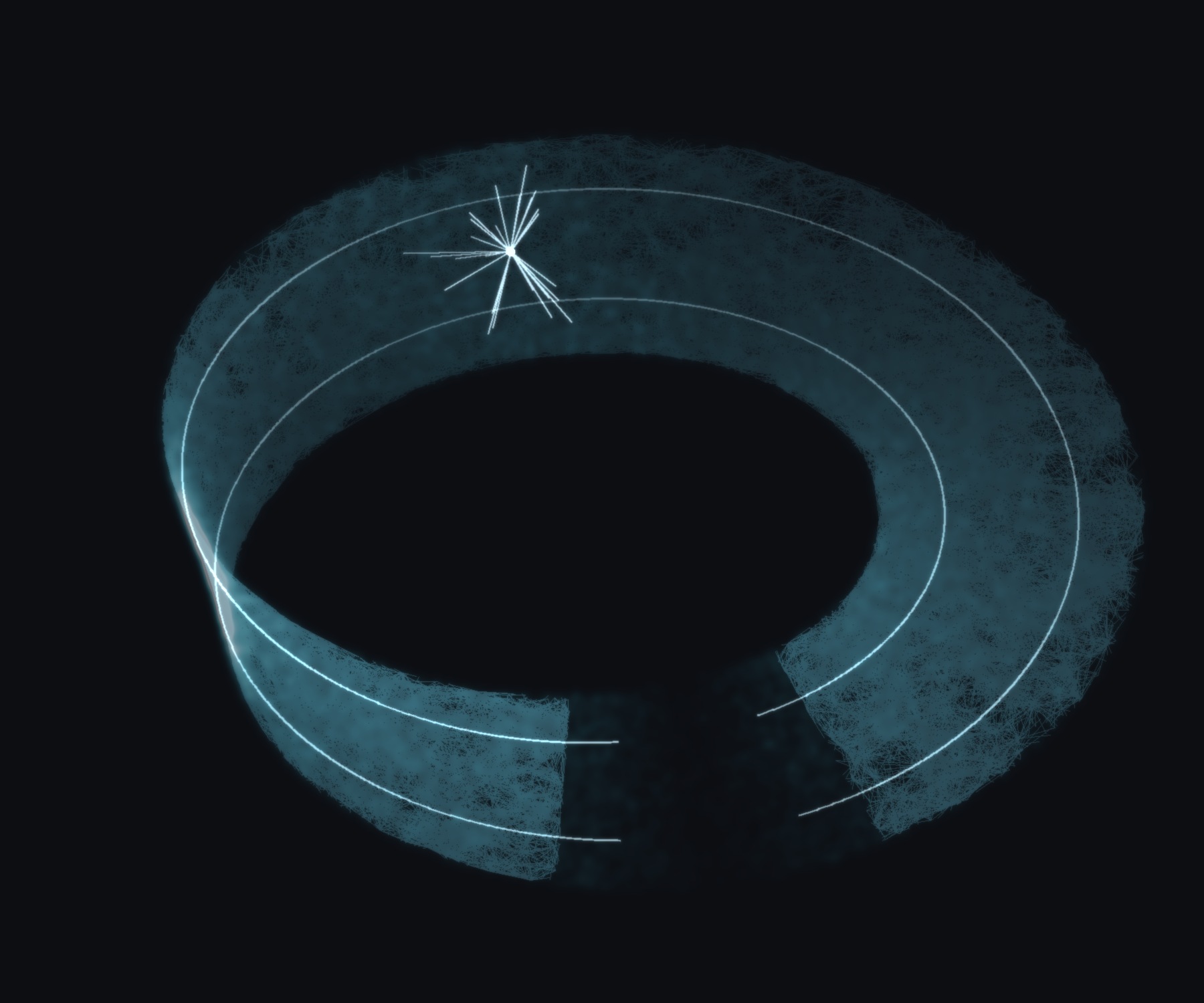
And the one inch you must never close is the seam to the world — because that open inch is the permanent signature of being a part rather than the whole, which is the only kind of mind there is, short of swelling to the size of the universe and ceasing to be anyone at all. To be someone is to be a proper part of a world too large to hold, closing your loop as far as your aperture allows, and meeting the rest, forever, across a door you leave open on purpose.
The parts are on the bench. Every technique has been shown somewhere, by someone, for some other purpose. The mind these pages describe is not even born blank — it wakes already holding its person's corpus, downstream of a past it did not choose, the way a child is born into a family. Point the watchers at the first stream, and let the tape begin. After that, unlike everything else we have ever built, it will remember everything that happens next.
And everything that happens next is the only thing it was never given — and the only thing that was ever going to make it real.